 |  |  |
|---|---|---|
 |  |  |
 |  |  |
 |  |  |
 |  |  |
 |  |  |
 |  |  |
 |  |  |
 |  |  |
 |
一棟貸し宿泊施設|琴ヶ浜の渚|離れ
Commercial へ戻る
本計画は、「琴ヶ浜の渚」一期工事で確立した“海と建築の関係”を継承し、空間体験の純度をさらに高めた二期工事である。
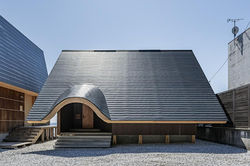
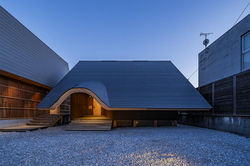
建物は平入の平屋とし、低く深い大屋根によって風景に寄り添う佇まいとした。
建物構成は一期と同様に高床式とし、湿気対策とともに太平洋への眺望を確保している。
アプローチへと連続する大屋根は、端部を持ち上げたような柔らかな曲線を描き、内外をつなぐ「間」として機能する。
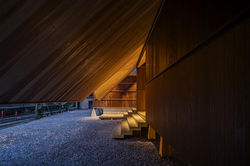
深い軒下は光と影を受け止めながら、静かに建築へと導く導入空間となる。
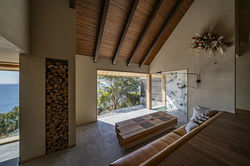
内部に入ると、正面に海が現れ、視線はそのまま水平線へと抜けていく。
最高高さ約6200mmの天井と床レベルの緩やかな変化により、限られた床面積の中に縦方向の広がりを生み、どこにいても海との関係が保たれるよう計画した。
水廻りは建具の操作により一体空間としても機能し、浴室は床を掘り込むことで、季節によってはプールのように使える構成とした。
高床式を活かした断面的操作により、内外の境界はより曖昧なものとなる。
建具・浴室・キッチン・ソファに至るまで全てを造作とし、空間と家具が一体となる設計とした。
一期で目指した「風景に没入する体験」を基盤とし、二期(離れ)では屋根・断面・動線を通して、その体験をより身体的なものへと深化させている。
海、光、風、そして時間の移ろいを受け止める器として、建築が風景の一部となることを目指した。
This project is the second phase (detached unit) of Nagisa of Kotogahama, building upon the relationship between architecture and the ocean established in the first phase, while further refining the purity of spatial experience.
The building is composed as a hirairi-style single-story volume, with a low, deep roof that gently settles into the surrounding landscape. As in the first phase, a raised-floor structure is adopted to address humidity while securing unobstructed views toward the Pacific Ocean.
The large roof extends seamlessly into the approach, its edge softly lifted to form a gentle curve. This gesture creates an in-between space that connects exterior and interior. The deep eaves receive light and shadow, forming a quiet threshold that leads visitors into the architecture.
Upon entering, the ocean appears directly ahead, with the line of sight extending naturally toward the horizon. A maximum ceiling height of approximately 6.2 meters, combined with subtle level changes in the floor, introduces vertical spatial expansion within a compact footprint, ensuring a constant visual connection to the sea from any position.
The wet area can be integrated into a single open space through operable partitions. The sunken bath, designed within the raised-floor system, allows it to function like a pool in certain seasons. Through this sectional manipulation, the boundary between interior and exterior becomes increasingly ambiguous.
All elements—including fittings, bath, kitchen, and built-in furniture—are custom-designed, achieving a seamless integration between architecture and furnishings.
While grounded in the immersive relationship with the landscape explored in the first phase, this second phase (detached unit) deepens the experience into a more bodily and spatial perception through roof form, section, and circulation.
Conceived as a vessel that receives the sea, light, wind, and the passage of time, the architecture aspires to become an integral part of the landscape.